
Get Sh*T Done | From Chaos to Clarity
The GSD Principle: How Solopreneurs and Small Businesses Beat Growth Paralysis with AI + CMO- Level Strategy

Tangled telephone wires showing a chaotic display.
Your competition isn't smarter than you. But they ARE selling more than you. Their idea or product is not better than yours. They're not better funded. They're not more talented.
They just stopped waiting until they had more time, more budget, or a bigger team and started Getting Sh*t Done with what they had.
If you're a solopreneur or small business owner, you know exactly how this feels. You don't lack ambition. You lack clarity and capacity, so you can’t convert. There are only so many hours in a day, only so much budget in the account, and only one of you trying to be the strategist, the marketer, the salesperson, the operator, and the finance department all at once. So, the highest- impact projects, the ones that would actually move revenue, get pushed to "next month." Then next quarter. Then they quietly stop getting mentioned at all.
You are not alone, and this pain point has a name: growth paralysis - the point where ambition outpaces the time, budget, and team available to execute it.
The good news is that growth paralysis isn't permanent, and it isn't solved by working more hours or hiring people you can't yet afford. It's solved with a system - the GSD Principle - paired with a resource that's finally leveling the playing field between solo operators and companies with ten times the headcount: AI- powered software, directed by CMO- level strategic thinking.
The Real Bottleneck Isn't Ambition - It’s Capacity and Budget
Most solopreneurs and small business owners aren't short on ideas. Talk to one for ten minutes, and you'll hear a dozen things they know they should be doing: fixing the slow follow-up process, cleaning up the janky intake form, building a real content calendar, automating the manual busy work eating their evenings. They know what needs to happen. What they don't have is the bandwidth or budget to do it all - or even to figure out where to start.
That gap between knowing and doing is where growth quietly stalls. It shows up as:
Decision paralysis. Too many possible next steps, no clear priority, so nothing gets picked.
Tool paralysis. A dozen open tabs comparing software, no time to actually implement any of it.
Hiring paralysis. Knowing you need help but not having the budget - or the time to manage someone even if you did.
Marketing spend that doesn't convert. Pouring what little budget exists into ads that drive traffic into a website, workflow, or customer experience that still isn't ready for it.
Every one of these is a capacity problem wearing a different costume. And capacity problems don't get solved by working harder. They get solved by removing friction - the unnecessary effort, delay, and manual work standing between your business and the revenue it's capable of - and by using software instead of hours.
Adopting the GSD Principle – Get Sh*t Done
GSD (actually known as "Get Stuff Done”) is a productivity and execution mindset built on prioritizing high-impact actions, eliminating distractions, and hitting your goals with minimal delay. For a solo operator or lean team, it's not an option. It's the only realistic way to make progress when you don't have the luxury, time, or budget to do everything.
Four pillars make GSD operational, especially for businesses running lean:
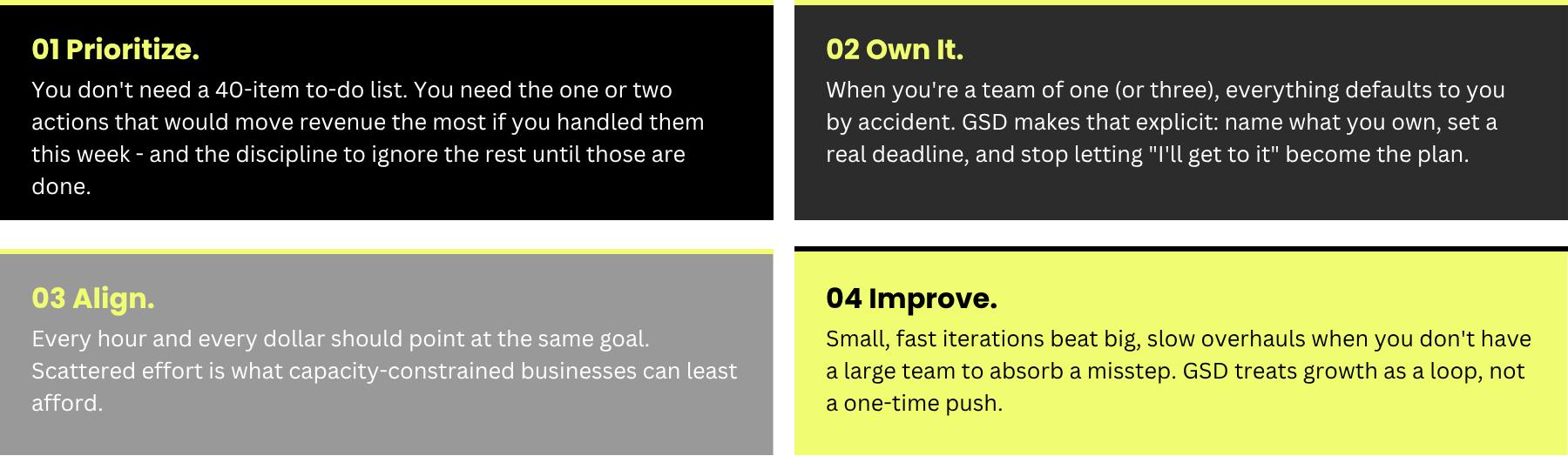
Four Pillars to make the GSD Principle operational.
GSD gives you the discipline to focus. But discipline alone doesn't create capacity out of nothing - you still only have so many hours in a day. That's where the second half of this equation comes in.
The Real Unlock: AI- Powered Software Guided by CMO-Level Decision Making
Here's what's changed in the last few years, and why it matters more to solopreneurs and small businesses than to anyone else: AI-powered software has quietly erased a huge chunk of the resource gap that used to separate a two-person shop from a company with a twenty-person marketing team.
The workflows that used to require multiple hires – sales, customer follow-up, content production, data analysis, CRM management, review monitoring - can now be handled largely by AI tools, at a fraction of the cost and time. That's real, meaningful leverage. But leverage without direction just moves you faster in the wrong direction. Buying five AI tools and hoping one of them fixes your growth problem is just tool paralysis with extra steps.
This is where CMO-level strategic thinking matters more than ever, not less. AI-powered software is the engine. Fractional CMO-level decision-making is what points that engine at the friction actually costing you revenue - instead of the shiny feature that happened to trend on LinkedIn or TikTok this month.
Paired together, they solve the two halves of growth paralysis at once:
CMO- level judgment identifies which friction point is actually stalling revenue - a broken follow- up process, a confusing intake form, a customer journey that loses people at the same step every time - and sequences the fix so it doesn't require a bigger team or budget than you have.
AI- powered software executes that fix at a speed and cost that used to be reserved for companies with full departments - automating the follow- up, rebuilding the workflow, monitoring the reviews, freeing up the hours you were spending on manual work that never should have been manual in the first place.
This is the model behind The C3 Brand Method™ - Clarity, Capacity, Conversion - and it's built specifically for businesses that don't have room for trial and error: get clear on the one friction point actually costing you growth, build the capacity to fix it using the right AI-powered tools instead of more headcount, and convert that fix into measurable revenue before spending another dollar trying to market around the problem.
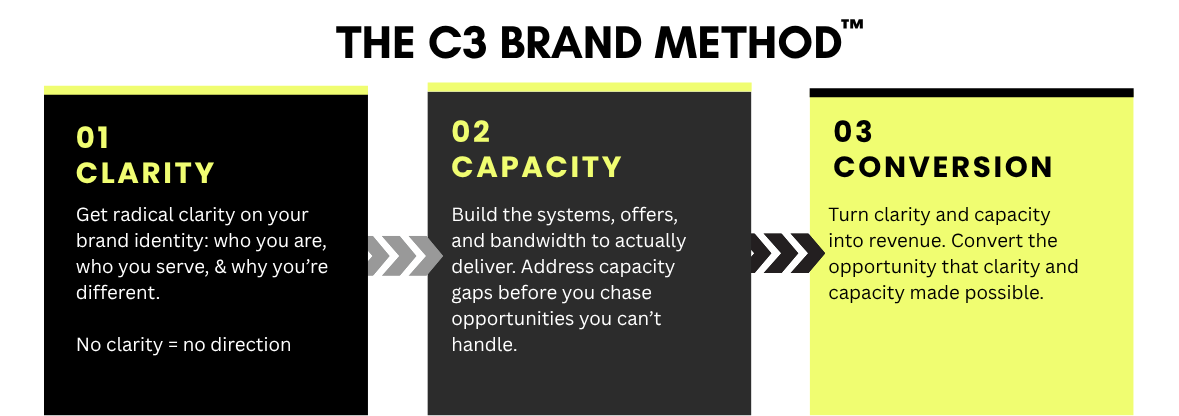
The C3 Brand Method: Moving Brands from Chaos to Clarity to Conversion
How Small Teams Compete Against Big Budgets
This combination is exactly how a solopreneur or a five-person team competes with a company that has fifty. Big companies win by throwing headcount and budget at problems. Small businesses win by being faster, more focused, and less encumbered - and AI-powered software plus sharp strategic prioritization is what makes that speed possible without the payroll to match.
A large competitor might need a meeting, a committee, and a quarter to fix a broken customer follow-up process. A lean, GSD-driven business can identify the friction, deploy an AI tool to solve it, and have it live within a week - because there's no committee to convince, just a clear priority and the capacity to execute it.
That's the real advantage small businesses have always had. GSD gives you the discipline to use it. AI-powered software, directed by CMO-level strategy, gives you the capacity to actually act on it.
Stop Waiting for More Capacity. Start Removing What's Costing You Revenue.
If growth has stalled and it isn't for lack of ideas, the problem probably isn't ambition. It's the friction quietly eating your time and budget before you ever get to the work that matters - and no amount of hustle fixes that on its own.
The C3 Brand Friction Finder Report™ is built for exactly this: a no-risk diagnostic that identifies the friction actually stalling your growth, so you know precisely where GSD, AI- powered software, and CMO- level strategy should be pointed first - before you spend another dollar trying to market around a problem marketing was never going to fix.