
Small Steps Create Big REVENUE Shifts
How the C3 Brand Method™ Moves Your Brand from Chaos to Clarity to Conversion
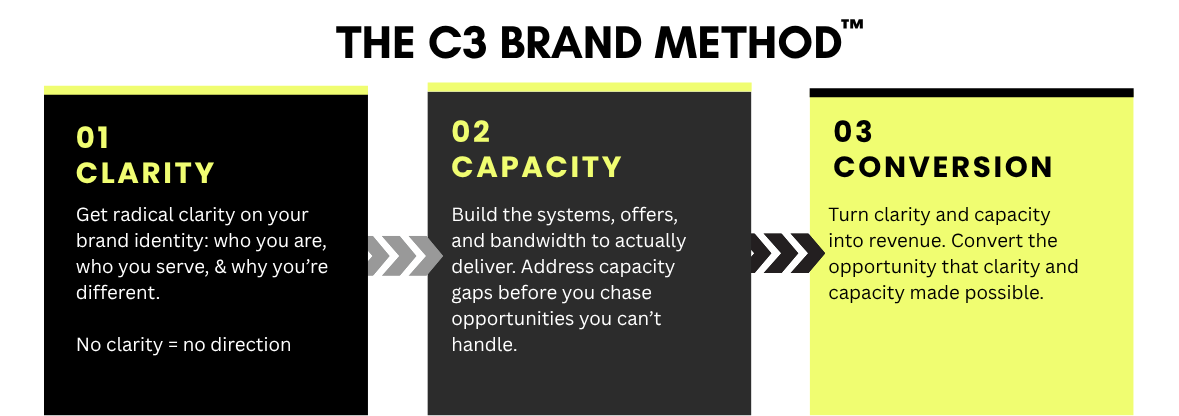
The C3 Brand Method™ - graphic showing workflow from clarity to capacity to conversion
Every organization faces friction. For nonprofits, it’s stretched resources and competing priorities. For solopreneurs, it’s time, bandwidth, and direction. For small and midsize businesses (SMBs), it’s inconsistent growth and internal misalignment. The instinct is to look for a big solution — a total overhaul, a costly campaign, a new tool. The reality: sustainable change comes from a sequence of small, focused steps that compound into a major shift.
The C3 Brand Method breaks that sequence into three practical stages: Clarity → Capacity → Conversion. Each stage uses small, measurable actions that build momentum and reduce risk. The result is not a band-aid fix but a durable pathway to growth.
Stage 0 — Own Your Chaos: Diagnose and prioritize what chaos looks like
Mixed messaging across channels
Undefined or competing priorities
Friction in donor/member/customer journeys
Lack of measurable goals or KPIs
Small steps that matter
Map the current state: capture processes, touchpoints, and revenue/donation flows
Collect quick feedback: 5–10 stakeholder interviews (team, donors, clients)
Identify one high-friction moment to resolve in the next 30 days
Why this works: Small diagnostic moves create clarity about where to focus effort. Instead of investing in broad, expensive initiatives, you learn what consistently blocks progress. This prevents wasted time and money and identifies a high-leverage point for immediate improvement.
Stage 1 — Clarity: Define strategy and alignment. What clarity looks like
A single, prioritized growth objective
Aligned roles and responsibilities
Clear messaging and positioning for target audiences (supporters, customers, partners)
Small steps that matter
Set one strategic objective for the next 90 days (example: increase donor retention by 10%; boost new client inquiries by 20%)
Create a one-page operating plan tying that objective to specific actions, owners, and metrics
Simplify messaging into a single value proposition and three supporting proof points
Why this works: Clarity converts uncertainty into a measurable plan. When the team understands the brand identity, goal, and how to contribute, execution accelerates. Small, focused commitments are easier to resource and more likely to be completed than sprawling initiatives.
Stage 2 — Capacity: Build the systems and bandwidth to deliver. What capacity looks like
Realistic workload distribution matched to actual bandwidth
Documented processes for the handful of tasks that repeat every week
The right AI-powered software tools doing the work that shouldn't require a person
Small steps that matter
Measure capacity across all three levers — people, budget, and tools — not just headcount. Track hours spent per week against the strategic objective, actual dollars available versus committed, and which tools are underused or missing entirely
Identify one recurring, time-consuming task (reporting, scheduling, first-draft content, data entry) and hand it to an AI tool instead of a person — freeing hours for the work that actually requires judgment
Set a lightweight monthly check: hours spent vs. hours planned, dollars spent vs. budget, and one tool or automation added or retired. Small, consistent measurement beats an annual capacity audit nobody has time for
Why this works: Capacity turns a good plan into something that can actually get done. A strategy is only as strong as the team's ability to execute it week over week. Without honest measurement of people, budget, and tools, even a clear objective collapses under its own weight. AI software increasingly does the job of an extra team member for the tasks that don't need a human — freeing limited people and budget for the decisions that do. Fixing bandwidth in small, specific increments — one process documented, one task automated, one tool added — builds delivery muscle without requiring a bigger team or a bigger budget.
Stage 3 — Conversion: Implement, test, and iterate on what conversion looks like
Predictable lead/donation flows
Repeatable sales or fundraising processes
Reliable measurement of outcomes and ROI
Small steps that matter
Launch a single test campaign or process change tied to the 90-day objective
Track 3–5 key metrics daily or weekly (open rates, conversion rates, donation frequency)
Run one iteration cycle every 30 days: analyze results, adjust, and re-run
Why this works: Conversion doesn’t require perfection on day one — it requires a repeatable feedback loop. Small experiments build learning and reduce the cost of mistakes. Over several cycles, optimization compounds into material improvements in revenue and engagement.
Case in point: compounding impact of small steps
A community nonprofit prioritized donor retention as its 90-day objective. They mapped the donor journey, added a personalized stewardship email series, and measured retention weekly. Within three cycles, they saw retention rise 12%, increasing predictable revenue without a major new acquisition spend.
A solopreneur refined a single service page, clarified their offer headline, and tested two CTA variants. Conversion rose 18% in one month, allowing them to replace low-paying gigs with higher-value clients.
An SMB standardized its lead handoff between marketing and sales, instituted a one-page weekly pipeline review, and focused on closing three highest-value leads each week. Sales cadence improved, and average deal size grew 15% over two quarters.
How The C3 Brand blends AI-powered tools with Fractional CMO expertise
AI-augmented diagnostics: We use AI tools to move fast - surfacing friction points, benchmarking capacity, and modeling scenarios in days, not weeks. Then we apply senior-level judgment to decide which findings are actually worth acting on.
Fractional expertise: We give you the right senior-level guidance without the cost and commitment of full-time hires, using AI to extend that expertise further rather than replace it.
Diagnostic rigor: We map friction points quickly and prioritize the highest-impact changes, backed by data pulled and synthesized through AI-powered analysis.
Operational focus: We convert strategy into one-page plans and short-cycle experiments that fit your team's capacity, including recommending the specific AI tools that free up your people, budget, and time.
Data-Driven Decisions: We define the few metrics that matter and set a cadence for review and iteration, using AI to keep tracking lightweight so it actually gets done.
Why this works: AI tools can process, draft, and monitor at a scale no small team can match on their own — but tools alone don't know which problems are worth solving first. A fractional CMO brings the strategic judgment to point that capability at the right target, so AI amplifies expertise instead of adding one more disconnected tool to the pile.
Homework Assignment: From chaos to clarity to conversion checklist
Week 0: Map current state and identify a few high-friction moments in your business or processes
Week 1–2: Define a 90-day objective and create a one-pager for each with a plan of action
Week 3: Execute — run the short-cycle experiments and small steps you defined, not the full 40-item list
Week 4: Measure results — check hours, dollars, and the metrics that matter against what you planned, and decide what to keep, cut, or automate
Need professional help? The C3 Brand is ready to assist.